

Tel :+86 - 17718123415
Email:info@sailsolaress.com
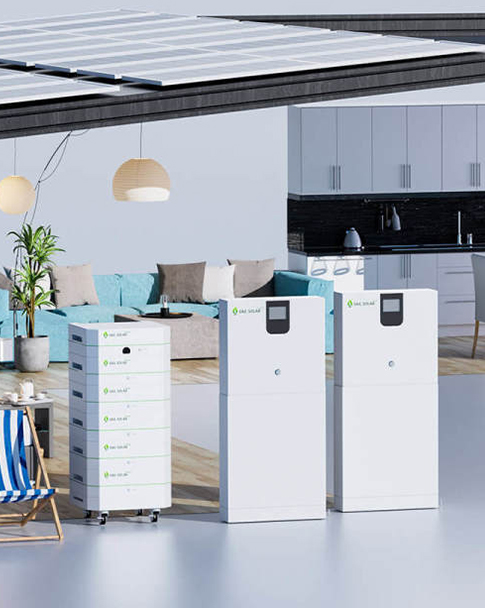
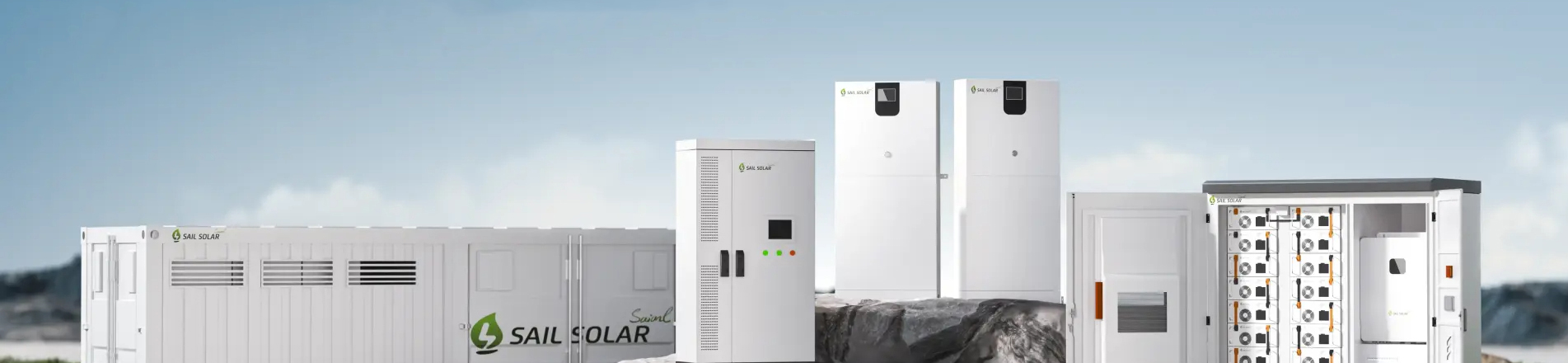
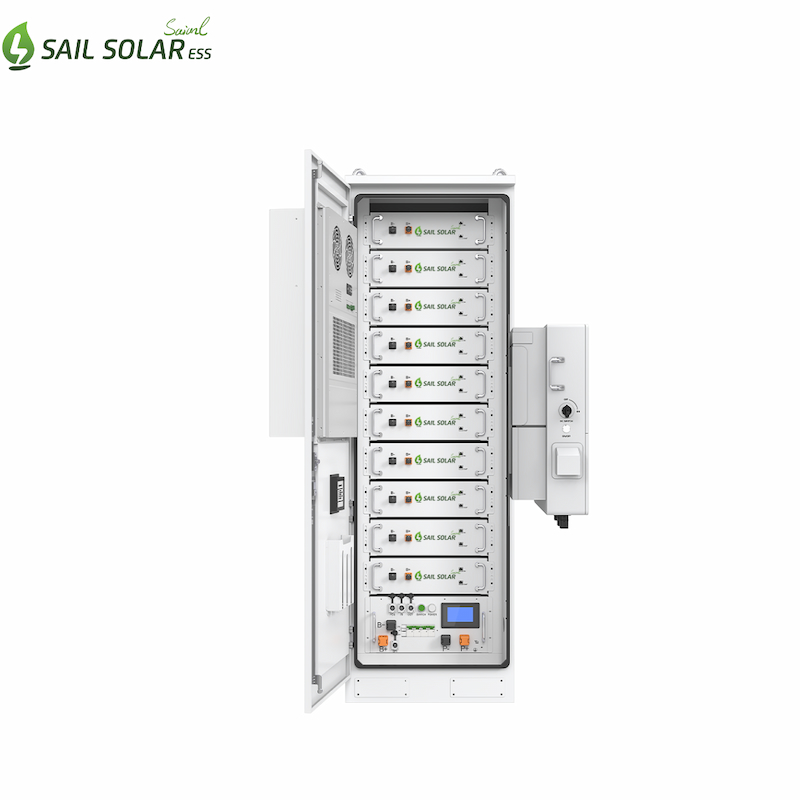
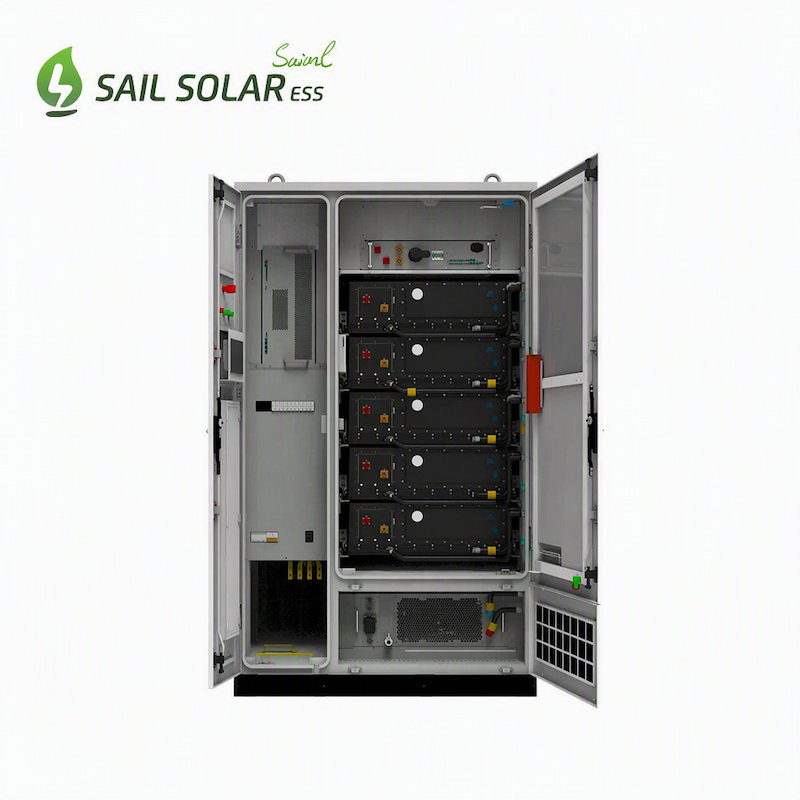
As more businesses and property owners invest in complete solar plus energy storage systems, many buyers overlook one critical factor: battery thermal management. How your storage cabinet removes heat directly impacts battery safety, runtime, operating cost, service life and total project ROI.
Two mainstream cooling solutions dominate today’s market: air cooling and liquid cooling. As a full system solar storage solution provider, we have delivered hundreds of complete turn-key projects for residential, commercial, industrial and utility-scale clients worldwide.
In this article, we break down their differences to help you make a confident purchasing decision.
1. How Each Cooling Technology Works?
Air cooling removes heat by blowing air across battery modules and electronics. Fans and air conditioner pull in ambient air and push hot air out of the cabinet. It relies on air flow to bring down surface temperature of battery racks.
Liquid cooling uses circulating coolant liquid inside sealed cold plates to carry heat away from battery cells. Heat transfers directly from modules into the liquid loop before being dissipated outside the cabinet. This delivers much higher heat-transfer efficiency than air-based solutions.
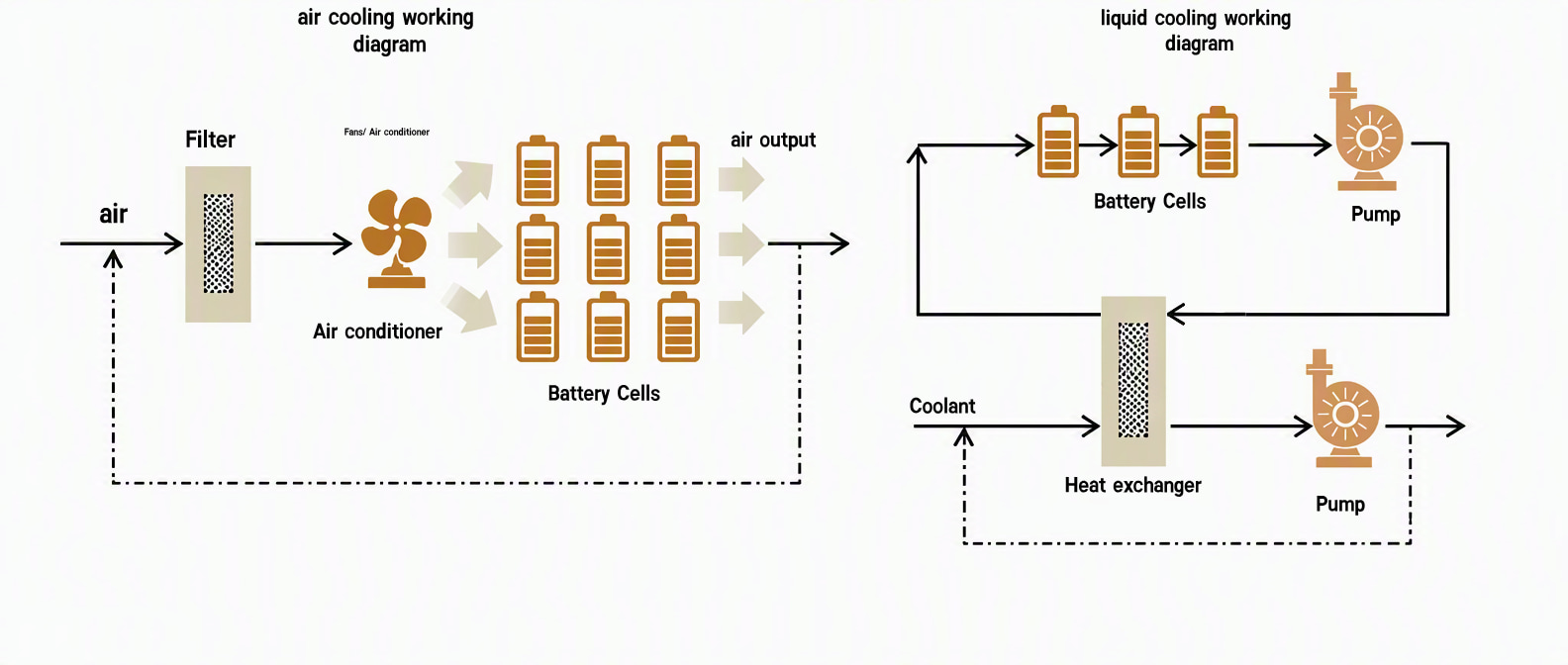
2. Core Comparison: Air Cooling vs Liquid Cooling
2.1. Suitable Project Scenarios
--Small to medium capacity projects
--Mild-climate sites
--Mid-low power charge/discharge rates
--Limited upfront-budget projects, small commercial or residential solar storage setups
--Large-scale, high-density energy storage projects
--Hot-climate regions, sites with large temperature swings
--Fast charge/discharge cycles for peak-shaving or heavy industrial loads
--Projects where space is limited and long-term battery lifespan is a top priority
2.2. Design & Complexity
2.3. Cooling Performance
2.4. Running Power Consumption
For the same target cabinet temperature:
2.5. Upfront Cost vs Long Term OPEX
2.6. Space & Noise
2.7. Safety & Risk Points
Air-cooled systems have no liquid-leak risks. Main safety concerns are fan failure or blocked air intake causing local overheating; regular visual checks can catch these issues early.
Liquid-cooled systems face theoretical risks of coolant leakage and material corrosion. Reliable full system providers solve these risks by applying strict sealing standards, high quality loop materials and multi-level leakage detection sensors during manufacturing and system integration.
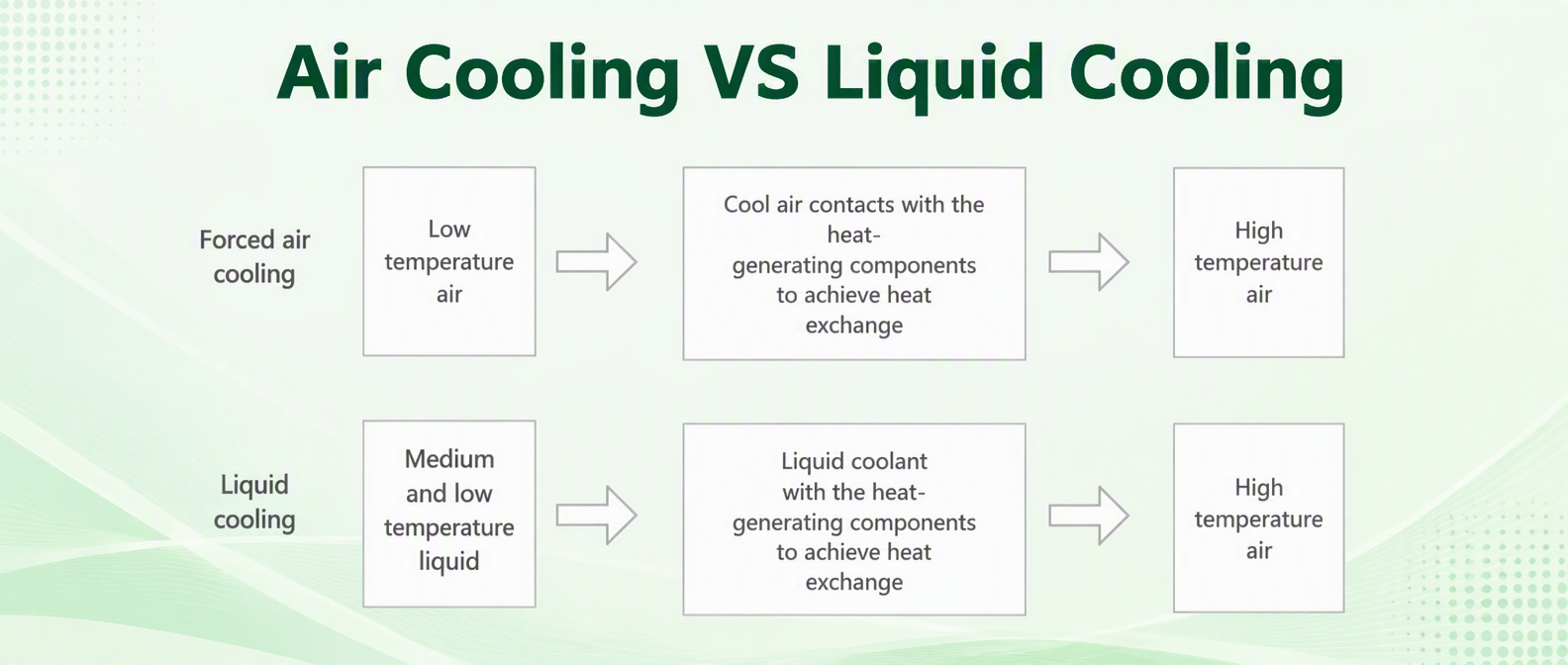
3. Which One Should You Choose for Your Solar Storage Project?
There is no universal “better” option. Your decision should be based on these practical project factors:
>Project size & power density: Go for air-cooled for small scale solar storage. Choose liquid-cooled for large capacity, high-density deployments.
>Local climate: Hot-area sites benefit more from liquid cooling; air cooling works well in mild-temperature zones.
>Budget strategy: If you focus on low cost for small projects, air cooling makes sense. If you value long-term battery life and low running losses, liquid cooling delivers stronger long-term value.
>Site space constraints: When installation space is tight, liquid cooled compact cabinets bring clear advantages.
As a complete solar storage system supplier, we do not push one single cooling technology to all customers. Our engineering team evaluates your local climate, load profile, available space and budget, then configures the most suitable solution for your specific site requirements.
FAQ
Q1: Is liquid cooling always better than air cooling for energy storage?
A: No. Air cooling remains cost effective and reliable for small capacity solar storage projects in mild-temperature environments. Liquid cooling shows its strengths mainly in large-scale or high temperature scenarios.
Q2: Will liquid-cooled storage systems have frequent leakage trouble?
A: Quality makes all the difference. Reliable full system integrators adopt industrial grade sealing and leakage monitoring. Most leakage risks come from poor quality hardware or unqualified system assembly, not liquid cooling technology itself.
Q3: Can I mix air cooled and liquid cooled cabinets in one solar storage plant?
A: Technically possible but not recommended. Mixed mode systems bring extra complexity for BMS and energy management platforms. Our technical team will give suggestions after reviewing your project parameters.
Get Your Custom Solar Storage Solution
If you are planning a complete solar storage system for residential, commercial/ industrial or utility-scale application, reach out to our technical team.
We provide free project assessment, custom system design and full cycle support for your complete solar system solution.
 IPv6 network supported
Leave A Message
Scan to Wechat :

Scan to WhatsApp :