

Tel :+86 - 17718123415
Email:info@sailsolaress.com
Wood Mackenzie’s latest report identifies commercial & industrial battery storage as a sleeping giant in the global renewable market.
Explore the key growth drivers, regional trends and long-term outlook for behind-the-meter energy storage.
Commercial and industrial (C&I) energy storage is widely recognised as the sleeping giant of the global battery storage sector, poised for years of sustained, strong expansion, according to new analysis from Wood Mackenzie.
The global energy storage industry continues its rapid transformation. Wood Mackenzie forecasts cumulative global energy storage capacity will grow sevenfold and surpass 7 TWh by 2035, with annual market demand climbing nearly 30% in 2026.
For many years, large utility-scale storage project assets dominated global installation figures. The latest outlook confirms a clear market shift: behind-the-meter C&I storage is emerging as one of the primary growth engines for the renewable energy industry.
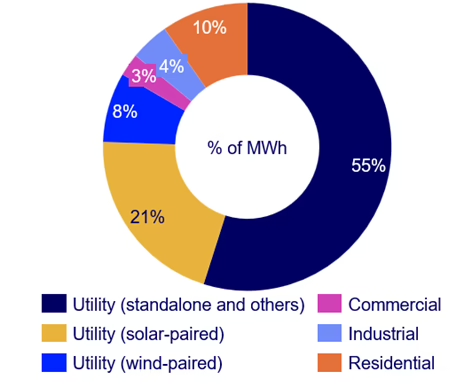
Global energy storage outlook by segment (% of total MWh installed in 2026)
Declining capital expenditure for battery storage systems remains the foundational driver for market expansion. Combined with updated grid codes, favorable policy frameworks and volatile retail electricity pricing, more commercial and industrial site owners are able to achieve positive financial returns from on-site battery assets.
Unlike front-of-meter utility storage projects, C&I storage delivers site-specific benefits for factories, warehouses and commercial facilities:
Business owners are no longer evaluating storage purely as a cost-saving tool. Energy resilience and energy independence have become high-priority strategic goals alongside project ROI.
Wood Mackenzie’s revised market outlook reclassifies utility-scale storage assets into three distinct categories:
-standalone storage
-solar-co-located storage
-wind-co-located storage.
This refined classification better reflects real project operation modes and revenue streams, instead of simply grouping all large-scale battery projects together.
Solar-plus-storage hybrid assets are projected to account for nearly one-third of all new storage capacity connected to the grid by 2035. This statistic highlights the strong technical and economic synergy between solar power generation and battery energy storage systems. On the technical side, batteries can smooth PV output fluctuation, shift daytime solar power to evening peak demand and meet grid connection requirements.
Economically, co-location shares land, site construction, transmission infrastructure and permitting costs, cutting overall CAPEX. Hybrid projects can stack multiple revenue streams: energy arbitrage, capacity credit, demand charge reduction and ancillary grid services, delivering more stable returns than standalone PV or storage alone.
Wood Mackenzie revised its utility storage market segmentation, splitting utility-scale storage into standalone, solar-paired and wind-paired categories, as these three segments grow at divergent speeds across regions.
Standalone storage remains dominant until 2035, while nearly one-third of new storage capacity by 2035 will be co-located with solar or wind assets. Regional markets show stark differences shaped by local policy and economics.
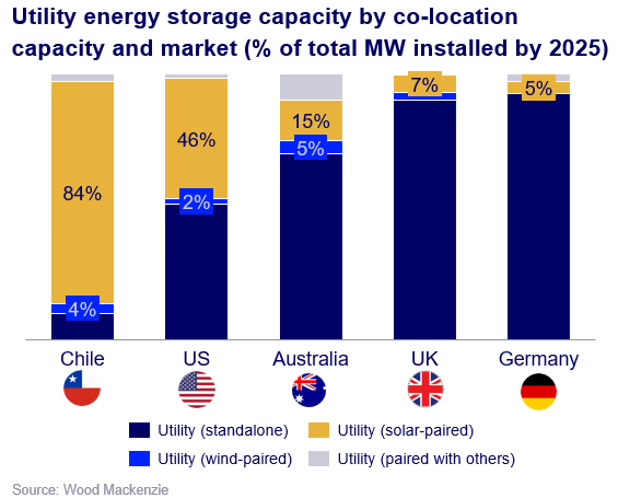
Europe leans heavily on standalone storage but will see rapid growth for paired storage.
The Americas, especially the US, have high shares of solar-paired storage, though this proportion will decline.
In Asia Pacific, India leads fast growth in solar-paired storage via new mandatory storage regulations.
Additionally, the energy storage market is entering its first replacement cycle. Retiring aged storage assets will create around 40 GWh of repowered capacity by 2030, primarily in the US, Japan and Germany.
Wood Mackenzie’s analysis confirms the global energy transition is moving away from purely centralized large power plants toward distributed, site-specific renewable assets.
The report signals that the era where utility-scale assets monopolize market growth is gradually coming to an end, as commercial and industrial site owners increasingly recognize the dual financial and operational value of behind-the-meter batteries.
As energy markets worldwide continue to liberalize and battery technology economics keep improving, C&I storage will keep expanding into new regions and new industrial sectors.
For EPC contractors, project developers and renewable energy stakeholders worldwide, the awakening C&I storage segment represents a multi-year market opportunity, requiring careful regional market research and adaptive project design to fully capture its long-term potential.
 IPv6 network supported
Leave A Message
Scan to Wechat :

Scan to WhatsApp :